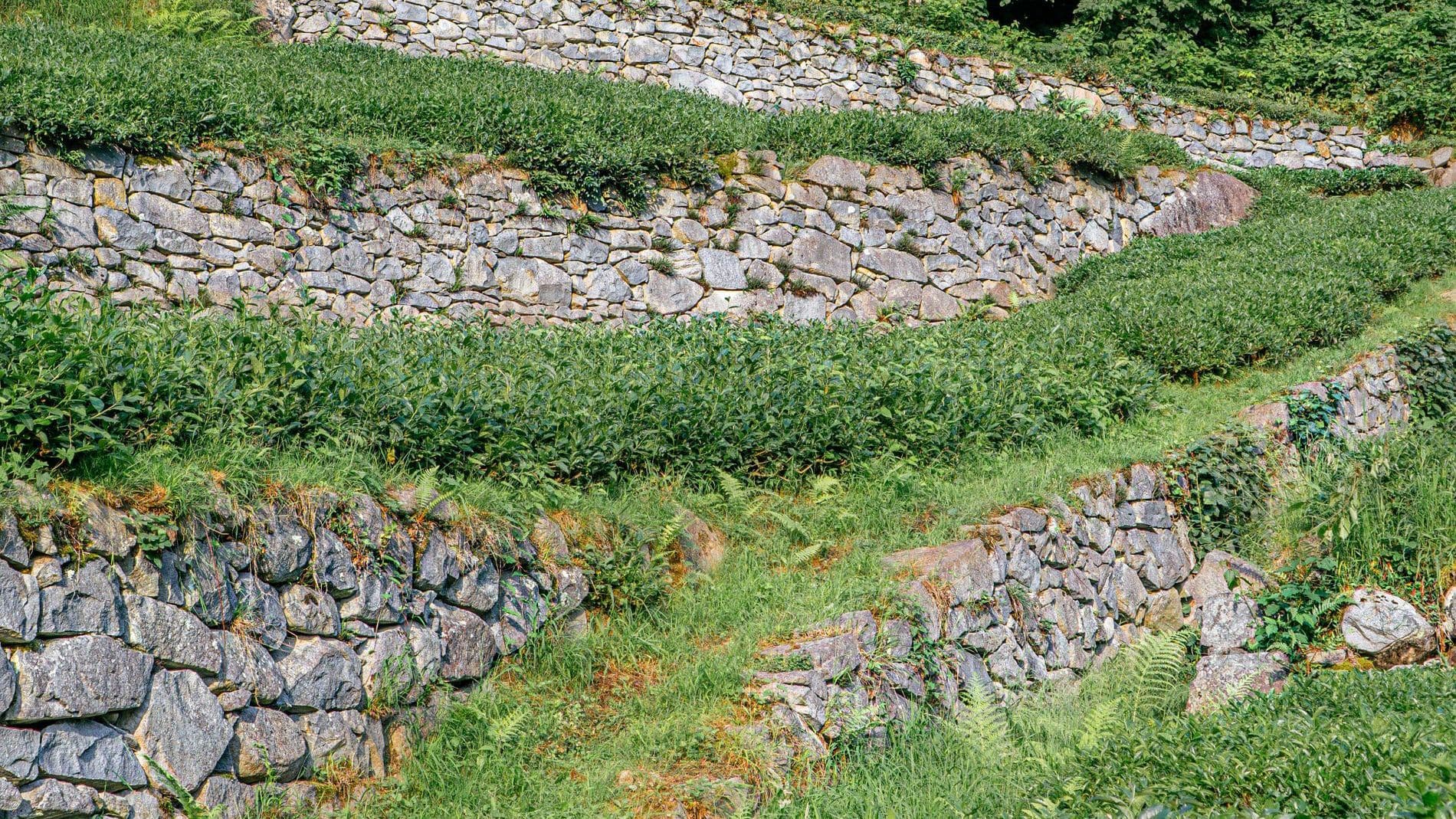
A retaining wall has one job: hold back soil that would otherwise slide. What makes that hard isn't the weight of the dirt — it's the water in it. Saturated soil is dramatically heavier and exerts hydrostatic pressure against the back of the wall. Nearly every leaning, bulging, or collapsed wall we're called out to inspect failed for that reason.
Good wall construction starts below grade. We excavate a trench and compact a leveling pad of crushed stone, then bury the first course — usually about a tenth of the wall's height. That buried course is what resists the wall being pushed forward at its base. A wall built directly on soil, with the first course sitting at grade, has already lost.
Behind the block goes drainage stone — clean, angular aggregate that water moves freely through — typically a foot deep, running the full height. Filter fabric separates that stone from the soil behind it so silt doesn't migrate in and clog the voids over time. At the base, a perforated drain pipe collects the water and carries it out to daylight, away from the wall.
Height changes the engineering. Low walls under about three feet are usually straightforward. Taller walls need geogrid — layers of reinforcing mesh extending back into the compacted soil, tying the wall and the earth behind it into one mass. Above four feet, Maryland jurisdictions generally require engineered plans and permits, and that's not a requirement worth dodging.
Terracing is often the better answer on a steep slope. Two shorter walls stepped back from each other handle the same grade change with less engineering, more planting space, and a result that usually looks better than one tall wall.
Caps finish the job — adhered with masonry adhesive, giving you a clean edge and, if you size the wall right, somewhere to sit. Lighting under the cap course is a small addition that makes a wall genuinely useful after dark.
Planning a wall, or worried about one that's started to lean? Call Artstrom LLC at (631) 639-1617 for a free evaluation anywhere in Harford, Cecil, Carroll, or Howard County.